@ModelAttribute, the number of parts grows quickly even when there are barely any files.@RequestPart is the more fundamental fix.After upgrading Spring Boot from 3.4 to 3.5, some multipart/form-data requests suddenly started returning 500s in staging.
At first I suspected something had changed in Spring binding, validation, or Jackson. But once I traced it down, the real culprit was not Spring at all. It was the embedded Tomcat.
This post is a record of how I tracked that down, and why I decided not to stop at a config-only workaround but to change the multipart request structure itself.
Before moving to Spring Boot 4, I first did a minor upgrade from 3.4 to 3.5.
I reviewed the changes from 3.4.x up to 3.5.14. Most of what stood out looked like library version bumps, and there did not seem to be any major application-level changes that would directly affect our business logic.
ObjectProvider to avoid initialization issues caused by converter dependency ordering changesIt deployed fine on the development server, and E2E tests also passed. So I assumed there would not be any major issue.
Then some multipart requests in staging started returning 500.
Spring Boot 3.5.x pulls the embedded Tomcat up into the 10.1.4x to 10.1.5x range.
In that version line, multipart processing limits were introduced as part of the response to CVE-2025-48988 and CVE-2025-48976.
multipart/form-data sends a request body as multiple pieces.
Content-Type: multipart/form-data; boundary=----X <- request-level header

------X                                 ← boundary (part begins)
Content-Disposition: form-data; name="title"
Content-Type: text/plain                ← part header

Stop gambling video                     ← part body
------X                                 ← boundary (next part)
The important detail here is that every field created by flattening a nested object into form fields is also treated as its own part.
------X
Content-Disposition: form-data; name="imageList[0].role"

REFERENCE
------X
Content-Disposition: form-data; name="imageList[0].info.subType"

other
------X
So if you send an array of 5 objects and each object has 6 fields, you can easily end up with 30 parts.
After this change, Tomcat introduced limits such as these:
maxPartCount: the maximum number of parts allowed in a single requestmaxPartHeaderSize: the maximum header size for each part
maxPartCountwas introduced with a default of 10.- Later, Tomcat 10.1.43 raised the default to 50.
If you exceed that limit, the request can fail in multipart processing before it ever reaches your application code.
In my case, the final exception showed up like this.
org.springframework.web.multipart.MaxUploadSizeExceededException: Maximum upload size exceeded
That message looks like a file-size problem at first glance, but the real issue was not file size but the number of parts.
When upgrading versions, I usually start with the release notes.
But the multipart-limit change on the Tomcat side was not surfaced prominently there. In the Miscellaneous section, I mainly saw a note like this:
Tomcat connector’s max parameter count can be configured using the server.tomcat.max-parameter-count property.So I assumed there would not be any major problem.
Later, while doing a postmortem, I found a mention that the CVE response had been included in the comments of Spring Boot 3.5.11 available now.
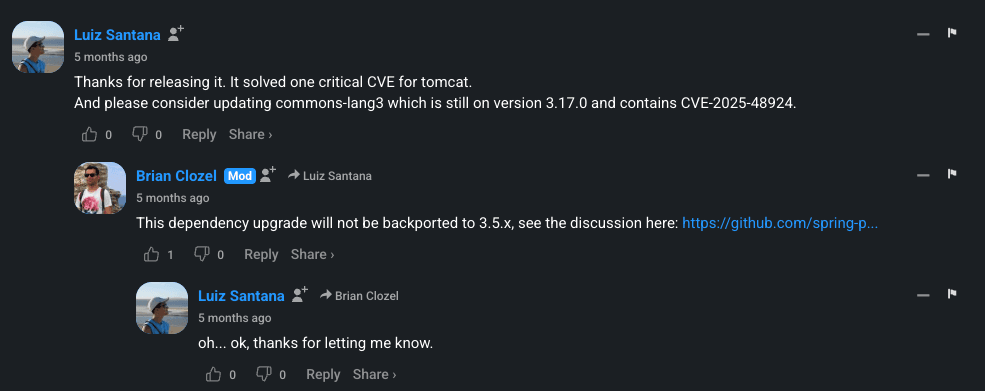
In the end, the lesson was simple: upgrade risk is not only about public framework API changes. You also have to watch for default-policy changes in the embedded server underneath it.
At that point, the options were basically these two.
server:
  tomcat:
    max-part-count: 200
A single config line can stop the incident immediately. From an operations standpoint, it is the fastest emergency response.
But this is still only a mitigation. As long as structured data keeps being flattened into many form fields, the number of parts will keep growing with the size of the data.
Fundamentally, I felt the right answer was to change the request structure.
The root problem was not Tomcat itself, but the design that sent structured data by flattening it into many form fields. Name-value form fields are convenient for flat data, but they are not a great fit for nested objects or variable-length arrays.
The Spring documentation points in the same direction.
Use
@RequestParamfor name-value form fields and@RequestPartfor more complex content such as JSON or XML.
You can think of @RequestPart as the part-level version of @RequestBody. Each part is deserialized through an HttpMessageConverter.
So it is much more natural to send the full structured payload as one JSON part and attach files as separate binary parts when needed.
Before — one part per field (part count grows with the data)
@PutMapping(consumes = MediaType.MULTIPART_FORM_DATA_VALUE)
public ResponseEntity<?> update(@ModelAttribute @Validated UpdateRequest dto) { ... }imageList.forEach((img, i) => {
fd.append(`imageList[${i}].uuid`, img.uuid);
fd.append(`imageList[${i}].role`, img.role);
// ... several more lines for each item
});After — one JSON part (part count = 1 + file count)
@PutMapping(consumes = MediaType.MULTIPART_FORM_DATA_VALUE)
public ResponseEntity<?> update(
        @RequestPart("data") @Validated UpdateRequest dto,
        @RequestPart(value = "files", required = false) List<MultipartFile> files) { ... }
const fd = new FormData();
fd.append('data', new Blob([JSON.stringify(payload)], { type: 'application/json' }));
files.forEach((f) => fd.append('files', f));The key detail is that the data part needs Content-Type: application/json, so Spring knows to deserialize it as JSON.
Now the number of parts stays fixed at 1 + file count, no matter how large the structured payload becomes.
Whether there are 100 scenes or 30 images, the structured text lives inside a single JSON part. That makes it much less likely to hit limits such as maxPartCount again.
Of course, that does not mean every multipart API should be rewritten this way. If you only have a few simple form fields and a few files, the traditional @ModelAttribute + multipart/form-data combination can still be perfectly fine.
But if the request includes variable-length arrays, nested objects, or many repeated fields, designing it as JSON part + file parts from the beginning feels much safer.
After this incident, I was left with two takeaways.
First, a version upgrade is not just about checking the public API changes listed in the release notes.
Things like embedded servers, security patches, and default limits can quietly change runtime behavior, and that quiet change can turn into a real incident.
That made me appreciate how important it is to have an environment where you can detect issues quickly and roll back immediately if needed. Once the issue is detected, reproducing it locally and tracing the root cause is relatively straightforward.
Second, external changes can become the trigger that reveals a weak design that was already present in your code.
At first my reaction was, “They suddenly limited the number of parts in multipart requests?” But after stepping back, I realized that using @ModelAttribute with a multipart request and flattening nested structures into many parts was not a design that would age well anyway.
So in the end, this incident was caused by a Tomcat change, but it also became a useful opportunity to re-evaluate the request structure itself.
If your multipart requests suddenly break after upgrading to Spring Boot 3.5 or later, it is worth checking part count limits, not just file sizes.
Strong ETags and Compression in Spring Boot (Tomcat)
How ControllerAdvice Handles Exceptions
SpringBootApplication Deep Dive (Why SpringBootApplication and EntityScan Should Be Specified Separately)
Is 1 Million INSERT Statements Really Worse Than 10,000 Batch INSERTs in Performance? (1) - Spring and DB