This English version was translated by Hermes Agent.
The service discussed in this post accepts text-based requests to start image generation and continues with post-processing on the generated result.
Instead of making the request-handling thread wait for post-processing, it saves the request first and hands off post-processing asynchronously after the transaction commits.
The processing flow is:
The listener can be simplified as follows.
@Async(AsyncProperties.ASYNC_LISTENER)
@TransactionalEventListener(phase = TransactionPhase.AFTER_COMMIT)
public void validate(TextToImageCreatedEvent event) {
    ...
}@Async separates the listener from the request-handling thread and runs it on a separate executor.@Bean(name = AsyncProperties.ASYNC_LISTENER)
public Executor asyncListenerExecutor() {
ThreadPoolTaskExecutor executor = new ThreadPoolTaskExecutor();
...
executor.setCorePoolSize(corePoolSize);
executor.setMaxPoolSize(maxPoolSize);
executor.setQueueCapacity(queueCapacity);
executor.setThreadNamePrefix("listener-");
executor.initialize();
return executor;
}We also enabled the setting that allows work already in progress to finish even when the server is shutting down.
Baeldung — Spring Boot graceful shutdown
taskExecutor.setWaitForTasksToCompleteOnShutdown(true);
taskExecutor.setAwaitTerminationSeconds(30);
Even with this setting enabled, however, we found cases where image-generation post-processing did not finish before the server went down.
At first, I thought:
“If the shutdown phase timeout is configured too, won't the server wait for the post-processing work to finish before shutting down?”
To answer that question, I first had to confirm what Spring actually waits for during shutdown.
@Async executor handle remaining work during shutdown?② lifecycle stop stops beans from the highest phase downward, with a separate timeout for each phase group. ③ Bean destroy runs in reverse creation order, one bean at a time on a single thread.② lifecycle stop starting with Spring Data Redis 3.2.)In this post, we will use test code and logs to verify the actual execution order of ContextClosedEvent, phase-by-phase SmartLifecycle stopping, and bean destruction.
A follow-up post will continue by checking when the @Async pool waits for work within this shutdown order, and what state external resources are in at that point.
server.shutdown: gracefulspring.lifecycle.timeout-per-shutdown-phase: 35sTo see how this works directly, I built a small environment that records the shutdown process.
The experimental code is available in Spring Shutdown Playground.
spring-context 6.2 without Spring Boot
context.close() directly in the test (the method called by the shutdown hook)[elapsed ms] [thread] event
① shutdown event · ② lifecycle stop · ③ Bean destroyDefaultLifecycleProcessor DEBUG logs as welltimeline [ 0ms] [Test worker] ② stop phase=1000 web-like ← experiment harness output
spring [Test worker] DefaultLifecycleProcessor - Stopping beans in phase 1000 ← Spring logSpring shuts down in three stages.
When ECS takes down the task, it sends SIGTERM to the JVM.
The JVM runs the shutdown hook,
and the hook registered by Spring calls ApplicationContext.close().
That, in turn, executes three main methods.
// AbstractApplicationContext.doClose()
publishEvent(new ContextClosedEvent(this));   // ① publish shutdown event
this.lifecycleProcessor.onClose();            // ② lifecycle stop
destroyBeans();                               // ③ Bean destroy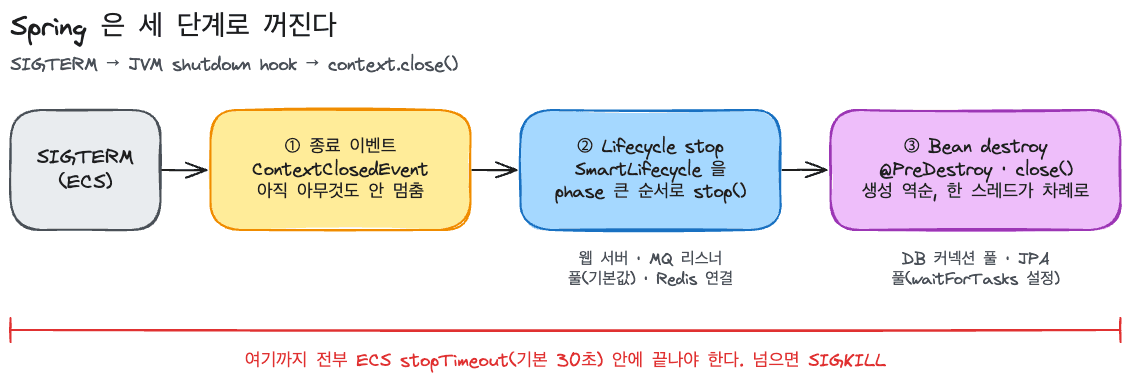
| Stage | What calls it | Nature |
|---|---|---|
| ① shutdown event | ApplicationListener<ContextClosedEvent> | A notification that the context is closing |
② lifecycle stop | Lifecycle · SmartLifecycle stop() | Stops ongoing work. It can be started again with start() |
③ Bean destroy | @PreDestroy · DisposableBean.destroy() · close() | Shuts down the bean. It cannot be used afterward |
To confirm that this really is the order, register
SmartLifecycle beans with phases 1000, 0, and -1000and then close the context:
...
timeline [ 0ms] ① ContextClosedEvent received

...
spring   DefaultLifecycleProcessor - Stopping beans in phase 1000
timeline [ 0ms] ② stop phase=1000 web-like
spring   DefaultLifecycleProcessor - Stopping beans in phase 0
timeline [ 0ms] ② stop phase=0 redis-like
spring   DefaultLifecycleProcessor - Stopping beans in phase -1000
timeline [ 0ms] ② stop phase=-1000 mq-like
...

timeline [ 0ms] ③ destroy third
timeline [ 0ms] ③ destroy second
timeline [ 1ms] ③ destroy first
Reproduce with:
./gradlew s1 --tests '*threeStagesInOrder'· test code
③ Bean destroy runs in the reverse order in which the beans were created.③ Bean destroy starts, ② lifecycle stop has finished.
② lifecycle stop and phasesLifecycle has the start, stop, and isRunning methods.
There is also SmartLifecycle, which extends this Lifecycle.
SmartLifecycle uses phase to determine startup and shutdown order.
The beans we commonly use have the phases below. (Verified in the source code.)
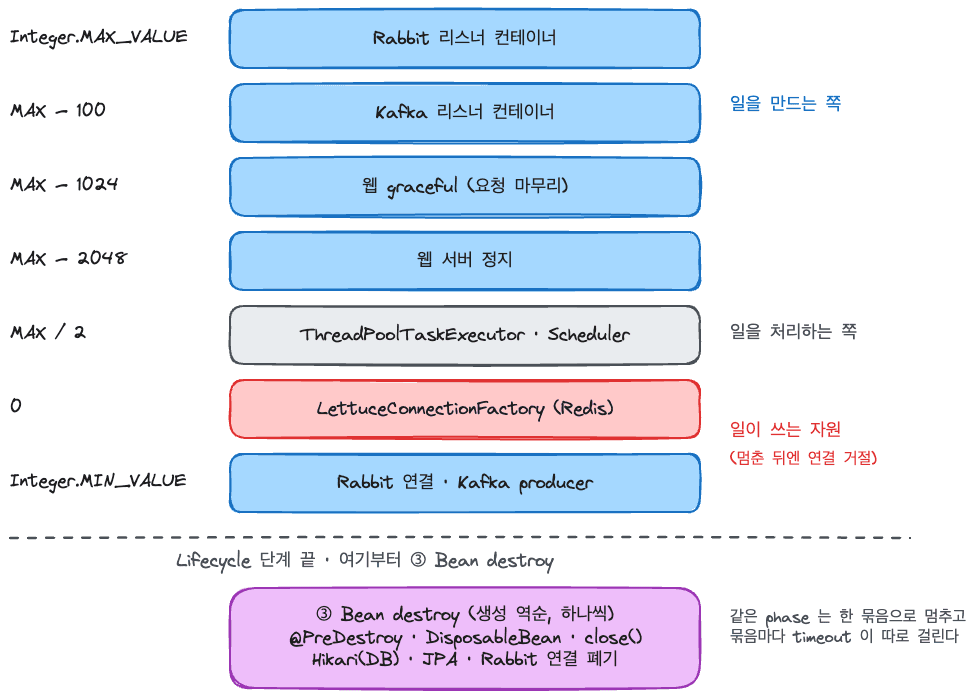
| phase | bean | role |
|---|---|---|
Integer.MAX_VALUE | Rabbit listener container | Produces work |
MAX − 100 | Kafka listener container | Produces work |
MAX − 1024 | Web graceful (Boot) | Produces work |
MAX − 2048 | Web server stop (Boot) | Produces work |
MAX / 2 | ThreadPoolTaskExecutor · ThreadPoolTaskScheduler | Processes work |
0 | LettuceConnectionFactory (Redis), ordinary Lifecycle | Resources used by the work |
Integer.MIN_VALUE | Rabbit CachingConnectionFactory, Kafka DefaultKafkaProducerFactory | Resources used by the work |
In general, shutdown proceeds in the order: producers → processors → resources.
MAX and the connection factory at MIN.)A bean that does not implement
Lifecycleis not assigned phase 0.
It is not a lifecycle target and only receives③ Bean destroy.
SmartLifecycleA SmartLifecycle determines its turn with getPhase().
It also adds stop(callback), which allows a callback to be run after shutdown completes.
Beans in the same phase receive stop(callback) as a group.
Spring waits until callbacks from the entire group arrive before moving to the next phase.
// `org.springframework.context.support.DefaultLifecycleProcessor`
private void stopBeans() {
    Map<String, Lifecycle> lifecycleBeans = getLifecycleBeans();
    Map<Integer, LifecycleGroup> phases = new TreeMap<>(Comparator.reverseOrder());  // ← step 2 also happens here

    lifecycleBeans.forEach((beanName, bean) -> {
        int shutdownPhase = getPhase(bean);
        // ← 1. group by phase
        phases.computeIfAbsent(shutdownPhase,
                phase -> new LifecycleGroup(...)
        ).add(beanName, bean);
    });

		// ← 2 & 5. iterate groups in descending order
    if (!phases.isEmpty()) {
        phases.values().forEach(LifecycleGroup::stop);
    }
}
SmartLifecycle beans by phase valuestop(callback) for the beans in the group in sequence
all callbacks in the group arrive or the specified time elapses
This is the upper limit for waiting for callbacks after calling stop(callback) for each phase.
When the time expires, Spring leaves beans whose callbacks have not arrived as they are and moves on to the next phase.
If we add a bean at phase 100 that never calls its callback and set the timeout to 500ms, the following log appears.
timeline [   0ms] ② stuck(phase 100) stop started — callback is never called
spring   DefaultLifecycleProcessor - Shutdown phase 100 ends with 1 bean still running after timeout of 500ms: [stuck]
timeline [ 511ms] ② stop phase=0 after-stuck
Reproduce with:
./gradlew s1 --tests '*phaseTimeoutMovesOn'· test code
Phase 100 ends after 500ms, but the log says that one bean is still running.
Therefore, when there are multiple phases, the upper limit is applied multiple times.
If timeout-per-shutdown-phase is set too high, shutdown can take a long time because Spring may wait for a long time at every phase.
There is one exception to the phase order. Before stopping a bean, Spring first stops the beans that depend on it.
// Summary of DefaultLifecycleProcessor.doStop() (spring-context 6.2)
String[] dependentBeans = getBeanFactory().getDependentBeans(beanName);
for (String dependentBean : dependentBeans) {
		// Stop beans that depend on me first
    doStop(lifecycleBeans, dependentBean, latch, countDownBeanNames);
}
...
smartLifecycle.stop(callback);
We made a dependent bean at phase -1000 depend on a target at phase 1000 with @DependsOn,
and placed a phase-0 middle bean between them.
timeline [    0ms] ② stop phase=-1000 dependent
timeline [    0ms] ② stop phase=1000 target
timeline [    0ms] ② stop phase=0 middle
Reproduce with:
./gradlew s1 --tests '*dependentStopsBeforeItsPhase'· test code
The dependent bean stopped before the target's turn (phase 1000), ahead of the middle bean at phase 0.
③ Bean destroyA single thread handles destroy methods.
// DefaultSingletonBeanRegistry.destroySingletons()

// Reverse registration order
for (int i = disposableBeanNames.length - 1; i >= 0; i--) {
		// The next bean starts only after this one finishes
    destroySingleton(disposableBeanNames[i]);
}
With two beans whose destroy methods each take 300ms, we can see this behavior:
timeline [   0ms] [Test worker] ③ slow-2 destroy started
timeline [ 308ms] [Test worker] ③ slow-2 destroy finished
timeline [ 308ms] [Test worker] ③ slow-1 destroy started
timeline [ 612ms] [Test worker] ③ slow-1 destroy finished
Reproduce with:
./gradlew s1 --tests '*destroyIsSequentialOnClosingThread'· test code
close() (Test worker), handles the work.=> If one bean's destroy method is blocked, every bean after it has to wait.
@DependsOn, constructor injection, and so on).What happens if a single bean has @PreDestroy, DisposableBean.destroy(), and @Bean(destroyMethod = …) all configured?
timeline [ 0ms] ③ @PreDestroy
timeline [ 0ms] ③ DisposableBean.destroy()
timeline [ 0ms] ③ destroyMethod(customClose)
Reproduce with:
./gradlew s1 --tests '*destroyCallbacksInsideOneBean'· test code
All three are called consecutively while cleaning up a bean during ③ Bean destroy.
@PreDestroyis often thought of as “the place called as soon as the shutdown signal is received,” but it is called during③ Bean destroy.
② lifecycle stopfinishes first. If a timeout occurred, unfinished work may still remain.
@Bean has close() or shutdown(), Spring infers it as a destroy method and calls it.When are resources such as Redis, Kafka, and databases cleaned up?
The point at which a resource is cleaned up depends on whether it implements Lifecycle, how its destroy callbacks are registered, and what each method does internally.
-> Both Lifecycle shutdown and destroy callbacks may be invoked, so you have to inspect the implementation.
Up through 3.1, Redis was closed during ③ Bean destroy.
Starting with 3.2, it moved to ② lifecycle stop.
| Spring Data Redis | LettuceConnectionFactory | Stage at which Redis closes |
|---|---|---|
| 3.1.x | InitializingBean, DisposableBean only | ③ Bean destroy |
| 3.2.x and later | Added SmartLifecycle (phase 0) | ② lifecycle stop |
Even with the same code, upgrading the Spring Data Redis version moved the point at which Redis closes one stage earlier.
Changes like this are difficult to notice from compiler errors or warnings alone.
Even if shutdown processing occurs during ② lifecycle stop, the component may reconnect and continue processing.
② lifecycle stop, but reconnect when the next request arrives.STARTED.// DefaultKafkaProducerFactory (spring-kafka 3.3.16)
public int getPhase() {
return Integer.MIN_VALUE;
}
public void stop() {
this.running.set(false);
// Close the existing producer (do not leave a rejection marker)
destroy();
}
private Producer<K, V> doCreateProducer(String txIdPrefix) {
...
// Create a new one if the previous producer was closed and cleared.
if (this.producer == null) {
this.producer = new CloseSafeProducer<>(createKafkaProducer(), ...);
}
return this.producer;
}// LettuceConnectionFactory (spring-data-redis 3.2.x and later)
private int phase = 0;
public RedisConnection getConnection() {
// If STOPPED, throw IllegalStateException:
// LettuceConnectionFactory has been STOPPED
assertStarted();
...These Lifecycle changes can also affect post-processing or cleanup work that uses Redis during shutdown!
Redis Connection Factory Earlier Graceful Shutdown after Spring 3.2 Upgrade
This issue covers a case whereLettuceConnectionFactory has been STOPPEDoccurred in@PreDestroyafter upgrading to Spring Boot 3.2.
This post confirmed three things.
① shutdown event → ② lifecycle stop → ③ Bean destroy.timeout-per-shutdown-phase is the upper limit for waiting for callbacks in each phase. (It is not the maximum amount of time Spring waits for shutdown to finish.)Now let us return to the final question. At which stage does the @Async pool wait for remaining work?
When the work-completion waiting setting we saw earlier is enabled, does the Redis connection remain alive while the work is waiting?
This will be covered in a follow-up post.
AbstractApplicationContext, DefaultLifecycleProcessor, DefaultSingletonBeanRegistryThe 400 I Mistook for a CORS Error — Logging Requests Rejected by Tomcat with a Valve
Strong ETags and Compression in Spring Boot (Tomcat)
Upgrading to Spring Boot 3.5 Broke Our multipart Requests
How ControllerAdvice Handles Exceptions